Quale allegria
(What Happiness)
a feature documentary by Francesco Frisari
Quale allegria
(What Happiness)
a feature documentary by Francesco Frisari

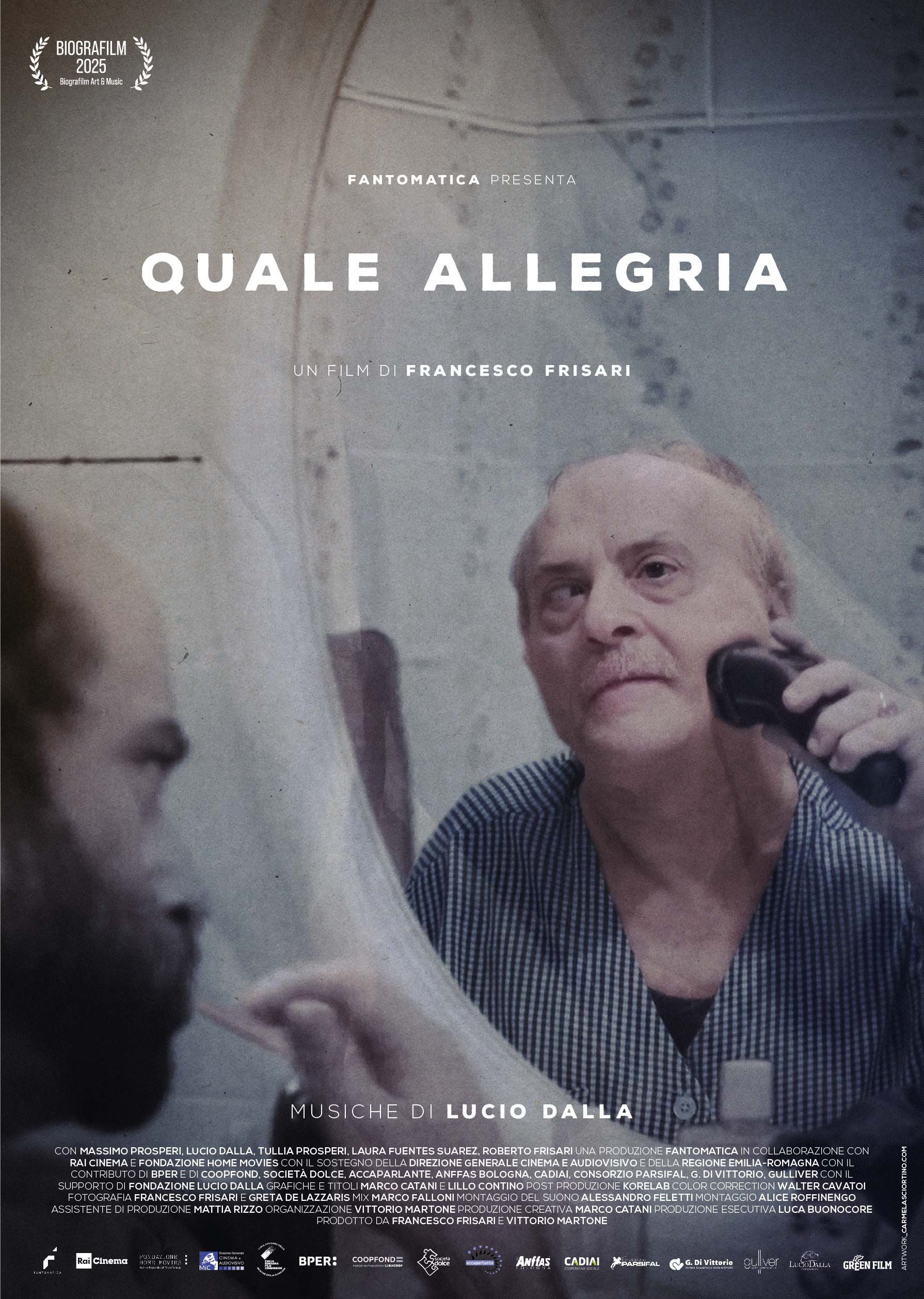
As a boy, the director was sure that his uncle Massimo and his favorite singer, Lucio Dalla, were the same person–both complicated, remarkable, different. The film explores that impossible similarity, which once helped him understand his uncle’s disability.

“My uncle Massimo is funny and complex. And above all he has a severe mental disability. As a child I thought not only that he resembled my favorite singer Lucio Dalla, but that actually he was Dalla, and that his playful madness would set us free”.
The filmmaker tells the story of his disabled uncle, drawing imaginary and poetical parallels with the life and music of the most brilliant and original Italian pop icon from the 70s and 80s, Lucio Dalla.
Never-before-seen footage from Lucio Dalla overlaps with scenes of uncle Massimo daily life today, blending memory with fantasy. An intimate, affectionate, and visionary portrait of disability and one family’s relationship with it.
The project
A documentary of observation and imagination — an intimate and poetic portrayal of disability, featuring never-before-seen footage, and the gaze, music, and voice of Lucio Dalla.
A film produced by Fantomatica in collaboration with Rai Cinema and Fondazione Home Movies, with the supporto of MiC – Direzione Generale Cinema e Audiovisivo and Regione Emilia-Romagna Film Commission, with the contribution of BPER and Coopfond, Società Dolce, Accaparlante, Anffas Bologna, Cadiai, Consorzio Parsifal, G. Di Vittorio, Gulliver, and with the patronage of Alma Mater Studiorum Università di
Bologna, Comune di Bologna, Fondazione Lucio Dalla, Legacoopsociali.
Director’s note
I believe my desire to make documentaries was born with my uncle Massimo, when I used to spend time just watching him—realizing how even the simplest gesture can reveal a person, how the ordinary and everyday can be both disorienting and extraordinary.
This film was made to give something back of that sense of wonder and mystery I felt when I was with him—to capture his complexity and my own sense of amazement, and to reflect on the way I saw him, or perhaps the way I oversaw him. And I think this act of seeing too much, of looking beyond, can be a form of cinema in itself—and one of its greatest freedoms.
Director’s note
I have wanted to make this film since my childhood, driven by the desire to preserve and share the complex surprises of growing up alongside my uncle. However, to authentically convey my experience and my uncle’s uniqueness, I realized I needed to go beyond mere facts and recover a vision I had as a child. Lucio Dalla, an artist whose music resonated deeply with both Massimo and me, then becomes an integral part of our narrative.
Drawing upon his private archives, we capture the essence of Dalla’s playful and whimsical nature, which resonated with the qualities I discovered and admired in my uncle. Simultaneously, through the archival footage that we have been recovering from numerous institutions involved in this film, I aspire to position my uncle’s story within the broader context of disability in Italy.